A book in development · Mihai Nadăș
The Operating
Advantage
Making Better Business Decisions When AI Changes the Work
What should a business own, how should the work change, and what evidence warrants the next investment?
This book explores those decisions through operating judgment, engineering and AI research. Start with a chapter about the costs a convincing demonstration can leave outside the frame.
Read the opening pages and the illustrated chapter, Count the Whole Cost.
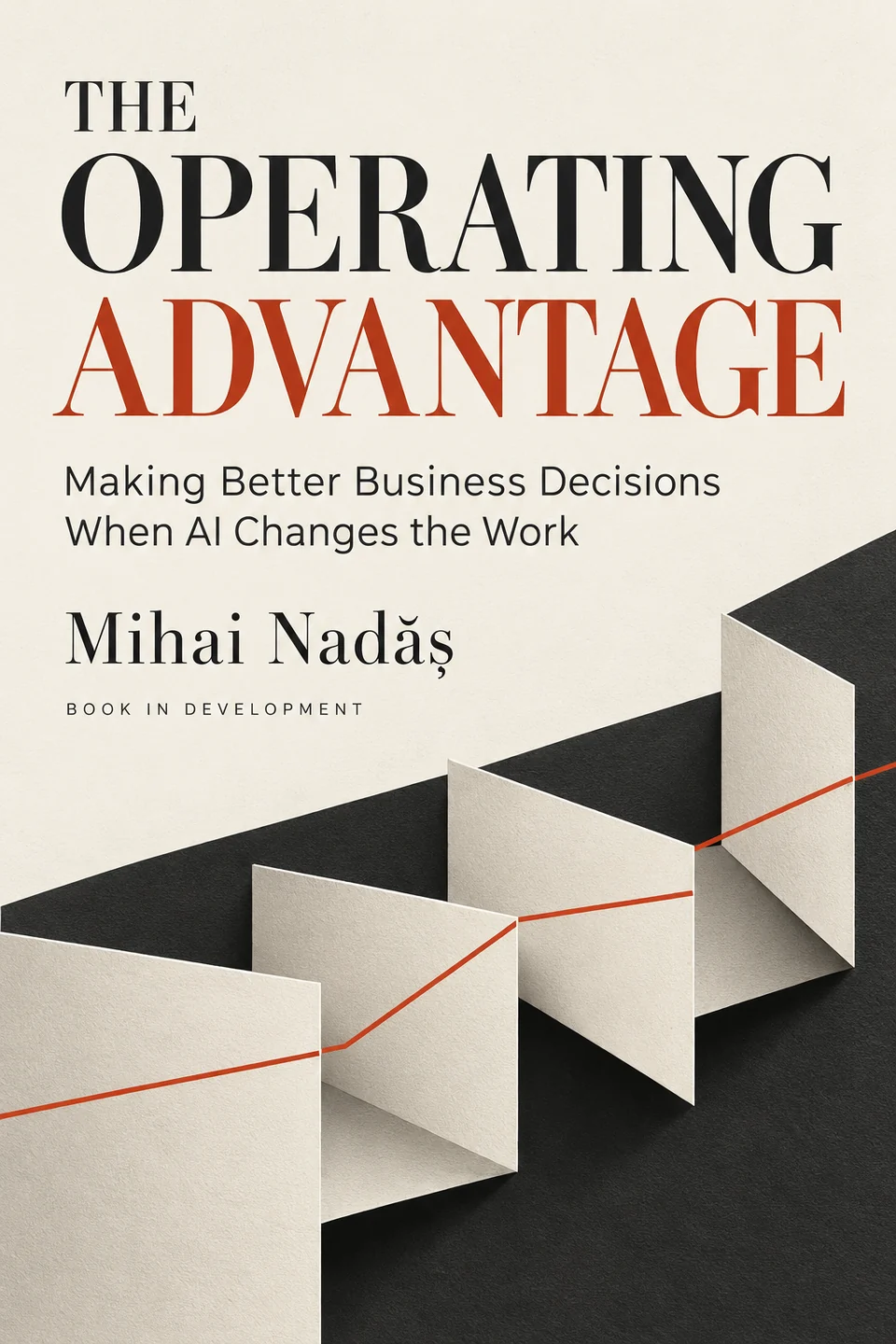
Making Better Business Decisions When AI Changes the Work
About the sample chapter
An AI pilot can make one task cheaper while leaving the business carrying more work. Drafts arrive faster, approvals take longer, and the promised saving depends on someone else's calendar. The investment decision needs to follow the work far enough to see where the cost lands.
This sample chapter develops one part of The Operating Advantage: how to compare the economics of a complete workflow before committing to scale. It uses a deliberately simplified example to make the arithmetic inspectable. The figures are assumptions, not results from a client or an experiment.
Mihai Nadăș
The Operating
Advantage
A book in development
Mihai Nadăș
The Operating
Advantage
Making Better Business Decisions
When AI Changes the Work
Public working sample
October 2026 · nadas.ro
About this edition
© 2026 Mihai Nadăș
This is an early public sample of a book in development. The title, cover, structure and text may change. Publication of this sample does not announce a completed book or a release date.
The chapter’s report-processing example is illustrative. Its figures are stated assumptions, not client results or experimental findings. References to the author’s research retain the limits of the linked work.
Concept cover prepared for this working sample.
Published on the author’s personal site
nadas.ro
The public sample
Contents
This preview includes the opening pages and one sample chapter. The proposed wider structure follows the reader below.
Preface
A company can buy the same model as its competitors and still get a very different result. Someone has to connect it to useful evidence, change the work, and accept responsibility for what leaves the organization.
This book starts at that point. I want to connect what a system can do with what an organization can use, maintain and justify. Engineering and AI research help expose assumptions. Operating judgment must also account for customers, capacity and economics.
The sample chapter begins with a drafting assistant and follows the report through review and acceptance. The example is deliberately simple. Its purpose is to make the reasoning available for inspection.
The wider question is who keeps the benefit once the capability becomes easy to buy. Customers may demand lower prices. Suppliers may absorb the saving at renewal. A business may retain an advantage through a combination of customer access, useful evidence and operating judgment that others struggle to reproduce. This book follows those possibilities far enough to make a choice between them. Sometimes the sensible choice will be a standard product. Sometimes it will be to simplify the work before buying anything.
Mihai Nadăș
October 2026
About the author
Mihai Nadăș

Mihai Nadăș is a technology leader and engineer based in Cluj-Napoca, Romania. He serves as Managing Director at Computacenter and is pursuing a PhD in artificial intelligence at Babeș-Bolyai University.
His career spans software engineering, architecture and organizational leadership, with earlier roles at Yonder, accesa.eu and METRO. His writing connects AI research and engineering with the economics, responsibilities and choices involved in putting technology to work.
Sample chapter
Illustrative economics · No client results
Count the Whole Cost
Consider a service business preparing recurring reports for its customers. Someone gathers the evidence, drafts the report, checks it, and releases it. A model can help write the first draft. The demonstration is persuasive: half an hour of drafting disappears in a few minutes. The customer, unfortunately for the demonstration, is buying a finished report.
The report still has to leave the company with the right numbers, the right commitments, and enough supporting evidence for someone to approve it. That is the unit of work the customer receives. It is also where the investment calculation should start.
I would measure cost per accepted report, then examine what happens to elapsed time and reviewer capacity. Drafting time belongs inside that calculation. Treating it as the whole calculation makes the answer depend on which part of the work happened to be easiest to demonstrate.
The distinction has support beyond this example. In the November 2023 version of Generative AI at Work, Erik Brynjolfsson, Danielle Li and Lindsey Raymond studied a staggered assistant rollout across 5,179 customer-support agents. Their productivity measure was:
“issues resolved per hour”
NBER Working Paper 31161 · November 2023 revision, abstract
The authors reported a 14% average increase, with a 34% improvement for novice and lower-skilled workers and little effect for experienced, highly skilled workers. That is evidence about completed support work in one setting, with substantial variation across workers. It neither predicts the return on a report-writing assistant nor establishes who ultimately keeps the economic benefit. The useful lesson is the measurement boundary: follow the work to a result somebody needs.
Follow one report to acceptance
Suppose the current process takes 60 minutes of staff time per accepted report. Gathering evidence takes 15 minutes, drafting takes 30, and review takes 15. At an assumed loaded staff cost of €40 an hour, the direct labor cost is €40 per report. Loaded cost here means an allocation that includes employment costs beyond salary. It is an accounting assumption, not a claim that every released hour can be converted into cash.
Now introduce a drafting assistant. Evidence gathering still takes 15 minutes. Producing and handling the draft takes five. Review takes 25 because the reviewer checks source alignment and corrects unsupported statements. These are hypothetical observations we would need to measure in a real pilot.
The process now uses 45 minutes of staff time. Labor costs €30. Add an assumed €1 per report for model use and related variable processing, and the apparent saving is €9 per accepted report. Drafting has fallen from 30 minutes to five, an 83% reduction. The direct variable cost has fallen from €40 to €31, a 22.5% reduction. Both percentages are correct. They describe different boundaries.
Even this wider boundary is incomplete. Someone has to connect the system to the evidence, maintain access permissions, respond to changes, and deal with failures. Suppose that work costs €1,500 a month, including recurring support and amortized setup. At 500 accepted reports a month, it adds €3 per report. The total becomes €34, leaving €6 of modeled saving per report, or €3,000 a month.
At 100 reports a month, the same fixed cost adds €15 per report. The total becomes €46. The proposal costs more than the baseline at that volume under these assumptions. The model and the drafting improvement have not changed. The amount of work carrying the fixed cost has.

This is a small model, with constant unit costs and no extra allowance for serious errors. Its purpose is to expose the assumptions that decide the result. A live investment decision needs evidence for those assumptions and a separate treatment of risks that should not be reduced to an average cost.
The reviewer gets busier
There is another consequence in the example. Review time rises from 15 to 25 minutes per report. With a fixed review budget of 100 hours a month, the baseline can support 400 reports. The assisted process can support 240, before allowing for interruptions or uneven arrivals. That is a 40% reduction in the review stage’s theoretical capacity.

The calculation does not establish actual end-to-end throughput. Review might have spare capacity, other staff might be able to help, or another stage might already constrain delivery. It does identify a question that the drafting benchmark misses: can the organization finish the additional work it can now start?
If review is already the constraint, faster drafting can increase the queue. Reports wait longer even while the team spends less total labor on each one. The person sponsoring the pilot may see a productivity improvement; the customer may experience a slower service.
The next useful investment could therefore be better evidence for the reviewer. A draft that links every factual claim to the relevant source may take longer to generate and cost more to process, yet require less checking. A narrower task with reliable inputs could also help. The choice depends on which intervention improves the whole flow.
This is why I would resist making the model leaderboard the center of the investment discussion. A model comparison answers a component question. The business needs to know what a different component allows it to stop doing, start doing, or do reliably at a larger scale.
Released time has several possible values
The €6 saving in the 500-report example is a modeled reduction in allocated cost. It becomes a cash saving only if expenditure actually falls. Salaried staff generally continue to receive their salaries after a task gets faster.
The time could still be valuable. The business might avoid an additional hire, reduce overtime, accept more paid work, shorten delivery time, or improve quality. Each route needs its own evidence. More capacity has little commercial value if there is no demand for it. Avoiding a hire is plausible only if the remaining team can carry the work at the required standard. Faster drafting has little effect on customer response time if approvals still happen once a week.
For the investment memo, name the route by which capacity becomes value. Then identify the decision that realizes it. Who changes staffing plans? Who opens the extra delivery slots? Who checks whether the new work earns enough to justify the effort?
Without that step, a business can accumulate local time savings while its cost base, revenue, and service levels barely move. The software may work exactly as demonstrated. The operating decision remains unfinished.
Who keeps the six euros?
Suppose the business resolves the review constraint and realizes the modeled €6 saving. There is still a strategic question: how much of it can the business retain?
If rivals can buy the same assistant, reproduce the integration and meet the same acceptance standard, the improvement can spread. In a price-sensitive market with comparable offers, a competitor may use part of the saving to win customers. Others then face a choice between matching the price and defending a difference the customer will pay for. The saving can be real while the margin advantage is temporary. Procurement has improved the business; competition has sent the customer the invoice adjustment.
That outcome depends on the market. Switching costs, scarce capacity, contracts or a service customers regard as different can slow price pressure. A company with unmet demand might instead retain its prices and use released capacity to serve more customers. These are competing routes from the same technical improvement, and they imply different investments. A volume strategy needs demand and delivery capacity. A premium service needs a difference that survives the customer’s comparison.
The report example gives us somewhere concrete to look. Perhaps the difficult reports require evidence that rivals cannot readily obtain, or judgment built into a reliable exception process. If those capabilities let the business accept work others must reject, or deliver a consequential answer sooner, they may support a stronger position. They must change a customer outcome. A proprietary folder full of documents is otherwise just a folder with a more ambitious description.
The supplier can also change the division of value. If the assistant becomes central to delivery and switching requires rebuilding acceptance rules, integrations and review history, a higher renewal price may consume part of the saving. Keeping those records usable outside the tool can improve the buyer’s options, provided the cost of doing so is justified. It creates bargaining room only if an alternative can actually carry the work.
I would therefore separate two decisions. First, does the complete workflow improve enough to justify adoption? Second, what prevents its benefit from passing to customers or suppliers? A business may reasonably adopt even when the answer to the second question is “very little.” It should budget for a competitive necessity accordingly, rather than valuing it as a durable source of additional profit.
Make the comparison fair
The baseline deserves the same scrutiny as the proposal. If the current report process includes repeated copying, poorly organized evidence, and unnecessary approvals, compare the assistant with a simpler process improvement. Templates, clearer responsibility, or an existing purchased product might deliver enough of the benefit with less maintenance.
Define an accepted report before comparing options. Keep the quality standard and intended workload comparable. Include failed attempts, retries, abandoned drafts, and the manual work that rescues an output. A pilot limited to clean examples says little about a service that must also handle missing documents and conflicting evidence.
Record the mix of cases. A lower average cost can conceal a small class of reports that consumes most of the senior review time. Those cases might justify a separate manual route. They might also be the cases customers pay the business to understand.
The research discipline matters here. In my note on threshold selection, I show how choosing a rule and judging it on the same test labels creates an optimistic result. The business analogue is a warning about evaluation design: retain a fresh set of work for the final comparison after adjusting prompts, routing, and acceptance rules. The classifier example does not estimate the size of bias in a commercial pilot.
Keep elapsed time alongside staff effort. Forty-five minutes of handling spread over three days is a different service from 60 minutes completed in an afternoon. Add the checks the decision actually needs: rework, missed deadlines, exception volume, and the workload of the people whose time is hardest to replace.
When the assistant is the right investment
The strongest case for adoption could still be straightforward. If the draft is easy to verify, evidence arrives in a consistent form, demand is sufficient, and recurring support is modest, the benefit may survive a conservative comparison. A less capable model might already be good enough. A more capable one might reduce review effort enough to justify its higher price.
The decision should be sensitive to those facts. In the illustrative example, holding the €9 contribution saving and €1,500 monthly fixed cost constant, the proposal breaks even at about 167 accepted reports a month. Above that volume it has a modeled cost advantage; below it the baseline costs less. A change in review time, error handling, price, or support effort moves that boundary.
Volume alone is insufficient. A single unacceptable confidentiality failure can invalidate a design with attractive average economics. Some requirements belong in the acceptance conditions before comparing costs. They should not disappear inside a small expected-loss allowance.
I would also test whether the purchased assistant provides the advantage the business needs. If competitors can buy it on similar terms, using it may become a sensible cost of staying competitive. A stronger distinction could come from the company’s ability to organize evidence, recognize exceptions, and deliver a reliable result. Those capabilities have to matter to customers and be worth maintaining. Their existence does not automatically create a defensible position.
What I would take to the investment meeting
Bring a short decision record with five things made explicit:
- The unit: an accepted report, with quality and release conditions specified.
- The comparison: the current process, a simpler improvement, and the assisted process across comparable work.
- The economics: observed staff effort and variable cost, recurring support, setup allocation, and the volume assumptions.
- The constraint: the stage limiting completion, its capacity, and the effect on waiting and exceptions.
- The next commitment: the money and responsibility being authorized, the evidence still missing, and the conditions for stopping or expanding.
For this example, I would authorize the next bounded test only after naming the owner of review capacity and the route by which released time will create value. The pilot should measure both. If the next sample shows that evidence-linked drafts reduce review effort, the calculation improves for a reason the business can explain. If they do not, the next decision might be to narrow the task, buy a standard service, or leave the workflow alone.
I would judge the investment at acceptance, and the advantage after the market has had time to respond. The first asks whether the system works for the business. The second asks whether the business gets to keep enough of the benefit to make the next commitment worthwhile.
The wider argument
From possibility
to operating advantage.
A proposed structure, developed around the decisions a leader needs to make.
- Where could advantage come from?
Choose a worthwhile problem, compare alternatives and decide what the business should own.
- What must change in the work?
Design roles, handovers and exceptions. Count the cost and assign responsibility.
- What warrants confidence?
Define evidence, understand its limits and decide whether to scale, revise or stop.